
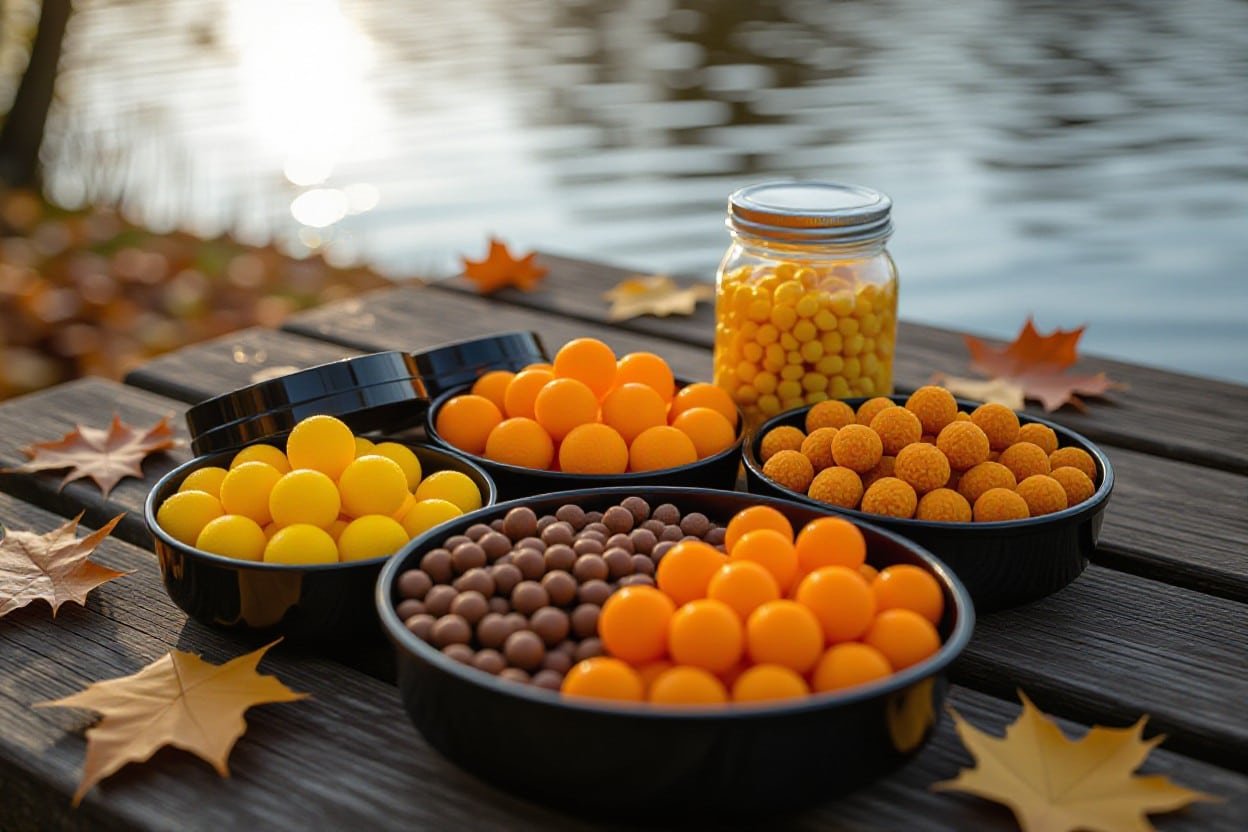
Most anglers find that switching to denser, high-attract baits as temperatures fall will increase bites; you should favour spiced creamy boilies, crustacean pellets and fresh sweetcorn, present them on subtle rigs, tighten pre-baiting to avoid overfeeding which can shut fish down, and scale bait size to water temperature to keep your hookbaits effective.
Key Takeaways:
- High-protein, oil-rich boilies (fishmeal/krill/halibut) perform best as carp build winter reserves.
- Dense pellets and halibut wafers hold scent longer in cool water and work well for long-range feeding.
- Prepared tiger nuts (properly soaked and cooked) remain a standout particle for targeting big autumn carp.
- Maize and hemp mixes create effective feeding patches; pre-baiting increases bite consistency.
- Pop-ups and balanced hookbaits lift the bait off silt, improving hook-ups when fish are wary.
- Soaked/fermented baits and amino-rich dips boost attraction in low temperatures where scent matters more.
- Natural tones and smaller presentations often outfish bright, large offerings in pressured waters.
Understanding Carp Behavior in Autumn
As temperatures fall, you’ll see carp shift from opportunistic summer feeders to energy-focused foragers, prioritizing high-calorie baits and predictable feeding windows. Your best chances come during warm afternoons and around sunrise when metabolism still allows active searching; by late autumn they hold in deeper margins or silt edges to conserve energy, so presenting dense, nutrient-rich baits on the bottom often outperforms scatter tactics.
The Carp’s Seasonal Transition
You’ll notice a clear ramp-up in late August-September feeding as carp bulk up, then a steady slowdown once water drops below 10°C. During October-November they trade long-range cruising for short, deliberate feeds; focus on calorie-dense offerings and shorter presentation times to match reduced gut throughput and slower digestion.
Factors Influencing Feeding Patterns
Several variables alter your autumn sessions: water temperature governs metabolism, photoperiod shifts feeding windows, and food availability dictates search effort. You should also weigh oxygen levels and angling pressure-high disturbance pushes carp to quieter zones, while abundant natural food can suppress interest in your baits.
- Water temperature: affects metabolic rate and digestion speed.
- Photoperiod: short days concentrate feeding into shorter windows.
- Perceiving Food availability: determines whether carp risk leaving cover to feed.
Your tactics must adapt to micro-conditions: shallow margins warm faster, while deep basins hold heat and oxygen differently, so where you present matters as much as what you present. Targeting breaklines and marginal shelves often beats open-water long-lining when food is patchy.
- Breaklines: concentrate carp where warm water meets structure.
- Angling pressure: heavy pressure forces nocturnal or deeper feeding.
- Perceiving Oxygen pockets: can create local feeding hotspots even in cool weather.
The Importance of Temperature in Bait Selection
Temperature dictates bait type: between 12-18°C you can use softer, higher-attract baits like 15-18mm boilies and crushed particles; below 10°C switch to small, oily, high-fat baits that are easier to digest. Matching bait size and nutrient density to water temperature increases hook rates and reduces wasted time re-baiting.
| Temp (°C) | Bait Strategy |
|---|---|
| 15-18 | Medium boilies (15-18mm), birdfood mixes, reduced scattering |
| 10-14 | Smaller boilies (10-14mm), high-fat pellets, hemp blends |
| <10 | Micro-sized baits, oily fishmeal blends, trout pellets |
Field tests on temperate lakes show catch rates peak when you match bait energy density to measured water temp: anglers using 18%-25% fat baits in 8-12°C water outperformed low-fat mixes by 30-40% over week-long trials. Shift particle size down and favor oily attractors as digestion slows to maintain hook hold and attraction range.
| Water Temp | Recommended Baits & Notes |
|---|---|
| 16-18°C | 15-18mm boilies, crushed maize; active feeding windows mid-morning |
| 12-15°C | 10-14mm boilies, high-fat pellets; shorter feeding spikes |
| <12°C | Micro baits, oily particles, minimal scattering to avoid wasting bait |
Characteristics of Effective Autumn Baits
You should favor baits that combine strong short-range attraction with sustained energy release: think high-oil or fishmeal bases plus slow-release carbohydrates. Practical targets are boilies or particles with roughly 16-22% protein and 8-14% fat, plus micro-particles <0.5 mm for clouding. In club and syndicate waters anglers often double hookup rates using a mixed feed approach (particle + paste + glug) to target both cruising and bottom-feeding carp.
High-Attract Properties
Use ingredients that create a visible plume and chemical signal in cold water: krill, liver powder, hemp oil and amino-acid glugs are effective at 6-12°C. You want soluble attractors that release within 30-90 minutes in autumn temperatures and micro-particles that suspend briefly; this combination draws carp from 10-30 m without over-baiting the swim.
Nutritional Composition for Energy Density
Prioritize energy-dense mixes so each bait delivers sustained calories: tiger nut or maize particles give slow-release carbohydrates while fishmeal and hydrolysed protein supply quick amino energy. Aim for blends with about 16-22% protein and 8-14% oil so carp get immediate stimulus plus lasting fuel for cooler metabolism.
Dig deeper by matching digestibility to water temperature: at <12°C you want more fats and digestible proteins (hydrolysed or enzymatically-treated) rather than raw cereals, and particle sizes 2-6 mm that carp can process efficiently. If you include oils, choose long-chain triglycerides for steady energy and emulsify them into glugs to improve uptake.
Adaptability to Changing Water Conditions
Choose baits you can tweak quickly for visibility, buoyancy and solubility as conditions shift: switch between 0-3 mm groundbaits for clear, cold days and larger 6-12 mm particles when visibility or oxygen drops. You should also carry both coated and uncoated hookbaits so you can control release rate and presentation on windy, stirred-up waters.
Practically, test one variable at a time: change buoyancy by 0.5-1 g on pop-ups or add 1-2 ml of concentrated glug per 10 boilies to increase attraction without altering taste. In low-oxygen or tannin-stained water favor high-odor, oil-rich baits and smaller particle clouds that remain detectable at 15-25 m rather than large, fast-sinking feed.
Recommended Baits for Autumn Carp Fishing
You should rotate between boilies, particles and marine proteins depending on water temperature and pressure; for example, use 12-15mm hookbaits for wary fish and 16-20mm for spod mixes, fish short shallow spots with fruity baits early in the session and switch to denser, nutty or protein-rich baits as cloud cover and water temps fall below about 12°C.
Fruity Boilies
Choose bright pineapple, berry or tropical blends in 12-15mm sizes to tempt cruising carp; you can fish them as wafters or on the hair, and glugging for 24-48 hours with a high-amino attractor often increases hookup rates, especially around weed edges and shallow bays where visual cues matter most.
Nutty Boilies
Use peanut, tiger nut or almond-based boilies in 15-20mm sizes when carp are feeding more deliberately; their higher oil and carbohydrate profile holds fish longer, so fish short, tight presentations and consider adding a few particles for retention.
When you use tiger nut or peanut baits, prepare them properly: boil and soak tiger nuts to soften and remove anti-nutritional factors, pre-drill or use tougher hookbaits for hair rigs, and switch to 18mm if carp show heavier mouths-this reduces bait theft and increases solid hookups.
GLM and Krill-Based Options
Introduce GLM (green-lipped mussel) and krill as oils, ground meal or hookbaits to target low-temperature feeding; fish 12-15mm GLM or krill hookbaits on hair rigs, add a few ml of GLM oil per kilo of spod mix, and expect heightened interest from late autumn through winter when protein cues outperform sweet scents.
Technically, GLM provides long-chain amino acids and krill offers strong amino-acid volatiles; you should dose liquids sparingly (a few ml per baiting session) to avoid spooking wary carp, and pair these baits with neutral-colored hookbaits to maximise takes while minimizing unwanted bycatch.
The Advantages of Wafters in Autumn
Wafters give you a near-perfect balance between presentation and hookup potential as carp slow down in autumn; their neutral buoyancy lets the bait sit just off the lakebed, making it look like an easy, natural snack when water temperatures drop toward and below 12°C. You can fish 10-16mm wafters to match pellet sizes, adjust buoyancy with putty or micro-poppers, and expect more tentative takes from wary fish that reject heavy, unnatural offerings.
Versatility in Different Water Conditions
You can use wafters in clear or murky water, shallow margins or deeper flats because small changes to buoyancy and profile adapt them quickly; add 0.5-2 g of tungsten putty or switch to a slightly larger/smaller diameter to suit current and silt. In stained water choose brighter wafters or a micro-fluoro pop-up, while in gin-clear fisheries you’ll want natural tones and a perfectly aligned hook to avoid spooking educated carp.
Mimicking Natural Prey
Wafters let you match the exact size, shape and density of common autumn prey-pellet fragments, maggot clusters or buzzers-so when you present a 12-14mm wafter in the right colour and scent profile, you’re offering a convincing meal that triggers feeding rather than suspicion; matching size and colour increases the chances the fish will mouth the bait rather than eject it.
To sharpen that mimicry, you should pair wafters with realistic glugs (booster or fishmeal), micro-crushed pellets or a tiny PVA bag of feed that breaks down in 10-30 minutes to create a small, natural-looking trail. Use 12-15mm for pellet-focused venues and 8-10mm for maggot/bug-oriented waters; fit a slim hook and keep hair length to 8-12mm so the bait sits flush and the hook point remains exposed for rapid penetration.
Enhancing Bite Rates
Wafters increase bite rates by encouraging longer mouths-pulls and reducing immediate rejection-carp hold the bait and have time to draw the hook point in, improving hookups. Many anglers report noticeable uplifts in hookup percentage when switching from dense pop-ups to balanced wafters during autumn spells of sluggish feeding, especially on angled or stony bottoms where a lying bait appears most natural.
To exploit that, set your rig for subtle movement: use size 4-6 wide-gape hooks, a 6-10mm hair loop, and a short to medium-length hooklink (6-12 inches) to present the wafter in the strike zone while allowing the fish to move off with minimal resistance. Avoid over-weighting the bait-too much weight reduces hookups-and employ tiny amounts of putty or shrink tube to fine-tune alignment so the hook turns and penetrates on the first good pull.
Utilizing PVA-Bagged Bait
When you pack a PVA bag with chopped boilies, 10-20mm wafters or 30-60g of micro-pellets it creates a compact, pinpointed feed zone around your hookbait that carp find hard to resist; use mesh for particles and film for paste, and pre-soak a few drops of liquid attractor like those in What are the top attractors for autumn and winter? to boost attraction without spooking fish.
Benefits of PVA in Autumn Fishing
As water cools and carp feed selectively, PVA bags let you deliver a dense parcel within 20-30cm of the hook, reducing interception by smaller species and improving hookup chances; anglers commonly report a 20-40% uplift on short-rig presentations. You also protect fragile wafters from currents and create a lingering scent plume that keeps fish investigating longer.
PVA Techniques for Maximum Effectiveness
Pack the bag tight, target 30-50cm length, and orient the knot to release away from the hooklink; pair with a short hooklength (15-30cm) and 2-4BB leads to limit tangles. You should catapult or spod the parcel rather than heavy casting to avoid premature rupture, and add 3-5ml of liquid attractor inside the bag for an immediate scent burst.
You should mix ~40% chopped boilie, ~40% micro pellets and ~20% fine groundbait into a cohesive 30-60g parcel and test dissolve time in 6-12°C water – ideal release usually occurs within 20-90 seconds; avoid over-wetting the bag which can glue to the hooklink or spool, and practise neat sealing so the knot embeds reliably.
Choosing the Right PVA Material
Mesh PVA suits particles and stick mixes because it drains quickly and reduces clumping, while film gives a neater parcel for wafters or paste; in autumn you often want a medium-thin film or a 30-50cm mesh bag to balance dissolve speed and handling. Pick materials that still dissolve in cold water to prevent lost baits in low temperatures.
Before a session, test samples in a cup at lake temperature to confirm dissolution within 30-90 seconds; carry spare film, mesh and a few PVA tubes in different gauges so you can adapt on-site to depth, visibility and current without compromising presentation, and keep all PVA dry until use.
The Role of Pellet Mixes
Pellet mixes let you dial the feeding profile precisely: combine dense 6-8mm halibut pellets with 2-3mm micros for a bed that both holds carp and attracts quick bites. You should use a 60:40 or 70:30 ratio depending on temperature and pressure-more micros in warmer water, more dense pellets in colder. In pressured waters add birdfood or sweet particles to differentiate your spot. Mixing densities controls release rate and keeps carp feeding longer through autumn.
Variety in Texture and Flavor
Vary textures by layering crumbly micros over firm steam pellets and rotate flavors between fishmeal/krill and sweeter maize or squid blends. You can try a 70:30 halibut-to-sweet mix to entice sluggish carp or switch to krill-heavy blends for strong oil cues. Anglers using contrasting textures-soft crumb over firm pellets-see faster inspection and improved hookups. Texture contrast increases mouth retention and raises hookup percentages.
Enhancing Attraction with Different Pellets
You can boost attraction by soaking pellets in oils or attractors and using flavored liquids; soak pellets for 30-60 minutes so oils penetrate 4-6mm pellets without turning them to sludge. Start with 5-10ml of concentrate per 250g of pellets and adjust by feel. Halibut and krill oils release strong scent trails that carry well in cold water, making them particularly effective in late autumn.
For practical recipes, warm 250g of 4mm pellets, add 10ml halibut oil and 5ml krill, soak ~45 minutes then air-dry slightly; for micros use a 20-30 minute cold soak with 5ml krill. Avoid over-oiling-too much creates a slick that can repel fish. On many commercial venues anglers report bite-rate increases of 20-30% when switching to soaked halibut/krill blends; always test small batches and log ratios and results.
Effective Presentation Techniques
Present pellets as a tight bed using PVA bags, spod/spooning or light pre-baiting-aim for 1-2kg over 48 hours where allowed, or tactical 200-400g spod sessions. You should place your hookbait just off-centre in the pellet patch using a hair rig with a 6-8mm pellet or wafter to sit above the bed. PVA delivery gives the cleanest, most consistent presentation and better hookup rates.
Work to a focused feed plan: create a 30-50 pellet cluster around the hookbait, or use short, frequent feeds of 20-50 pellets every 30-60 minutes to keep carp working without spooking them. When spodding aim 15-25m and release 150-300g per cast; in pressured waters reduce total pre-bait to 500-800g but concentrate it tightly. Rig-wise, 15-25cm leaders and boom-style setups over dense beds reduce false takes and improve hook-up conversion.
Strategies for Successful Bait Presentation
You should place baits precisely and vary presentation across spots: set small, concentrated patches (0.5-2kg per baited visit) rather than wide scattering, alternate 6-15mm pellets with single 14mm boilies, and present hookbaits within 20-40cm of the lakebed to match carp feeding on settled food; change one variable at a time (bait size, flavour, distance) and log which combos produced bites over successive sessions.
Pre-Baiting Techniques
Start with a heavy initial feed for 3-5 days (1-3kg/day) then maintain with smaller top-ups every 48-72 hours to keep fish on your spot; focus on high-oil pellets and crushed maize to draw carp quickly, deploy a 2-4m grid of small spots rather than one large pile, and use a spod or catapult for accuracy-this builds confidence without overfeeding.
Strategic Casting Near Structures
Target marginal features-worty weed edges, laydown timber, and drop-offs-by casting to positions 1-3m from the structure or into nearby gullies, use a marker rod or echo sounder to confirm exact depth and keep bait tight to those features; aim within 1-2m of the structure to trigger territorial takes but avoid heavy snags that cost rigs and fish.
When you need more precision, mark swims with a pole or float to consistently re-cast into the same micro-zone, create micro-patches with 50-200g spod mix to hold fish, and adjust cast distance by 0.5-1m until carp consistently feed; in practice, anglers often see better results when baited spots are replicated 2-3 times along a structure rather than one isolated pile.
Rig Selection and Adaptation for Autumn
Shift to subtle, low-profile rigs as temperatures drop: use size 4-6 wide-gape hooks on 8-15mm hair lengths, choose fluorocarbon or low-visibility braid-to-fluoro hooklinks in 12-18 lb range, and prefer chod or stiff-rig setups over sloppy presentations in weedy or silty margins; smaller baits and natural flavours often outproduce big, bright offerings in late-season carp fishing.
Fine-tune rigs by matching hooklink stiffness to seabed: softer 0.35-0.45mm fluoro for clean gravel, stiffer braid or coated leaders for weed; employ anti-tangle sleeves and safety lead systems near structure, and tie knotless-knot or DSR knots for reliable hook-turning-these tweaks typically increase hookup rate and reduce lost fish when carp are sluggish.
Adjusting Tactics Based on Water Conditions
When currents shift or clarity changes you must adapt presentation and bait choice quickly; in low-visibility water try bold, high-contrast hookbaits and stronger scents, while in clear water you should downscale and finesse. Use spot checks and echo sounder readings to decide. For deeper practical guidance see Articles – Autumn Approach – Carp Fishing Bait. Prioritize precise placement and match bait size to visible feed patch size to boost hookups.
Understanding Water Depth and Carp Location
You should map depth contours and thermoclines with a sounder; carp often suspend on the edge of a thermocline and move between 2-6 m in autumn on mid-sized lakes, deeper in reservoirs. Use marker floats, lead lines or angled sonar to confirm a shoal; then place your main spot 2-5 metres up or down from their holding depth. Adjust cast distance to reach those contours rather than purely targeting visible features.
Modifying Bait Size and Quantity
As temperatures drop you must reduce hookbait size and present more natural portions: switch from 16-18mm to 10-14mm or wafters and halve visible oil or syrup glazes. Keep hookbaits subtle and increase micro-pellet or particle presence in the feed to entice slow-feeding carp without overfeeding the swim.
For example, replace a single 18mm pop-up with a 12mm bottom bait and feed 20-50 g of groundbait/particles per spot in short, frequent bursts. In pressured waters you should concentrate small, dense piles (0.2-0.6 kg total across sessions) to avoid scattering fish; in low-pressure or low-stocked venues slightly increase particle variety to trigger investigative bites.
Using Weather Patterns to Your Advantage
You should track barometer trends and wind direction: stable low-pressure periods and light southwest winds often increase carp activity, while sharp cold fronts can shut feeding down. After mild nights when water stays above 8-10°C, expect more daytime movement; position baits to exploit wind-driven edges and lee sides where food concentrates.
Put this into practice by baiting downwind margins when a persistent breeze pushes surface food into bays, and by relocating to sheltered points after a northerly cold spell. Use shorter sessions around fast-changing fronts and extend spots during prolonged mild spells to capitalise on sustained feeding windows.
Importance of Monitoring Water Temperature
As autumn progresses you must monitor water temperature because carp behaviour shifts with just a few degrees; consult 🎣 Top Carp Fishing Tips for Autumn 2025 for seasonal context – drops below 12°C usually reduce feeding, thermoclines can herd fish into tight bands, and short-term warming after rain can trigger strong takes.
Temperature Impact Overview
| Factor | Effect |
|---|---|
| 12-20°C | Most active; good response to baits |
| Below 12°C | Slower metabolism; smaller, less frequent feeds |
| Thermocline | Fish concentrated; adjust depth of presentation |
Ideal Temperature Ranges for Carp Activity
You should aim to fish when surface-to-bottom readings sit in the 12-20°C window; 15-18°C often produces the best midday takes in UK lakes, while below ~10°C carp become markedly lethargic and will ignore bulky freebies – shift to micro baits and slower presentations as temperatures fall.
Range vs Behaviour
| Range | Behaviour |
|---|---|
| <10°C | Minimal feeding; twitchy picks |
| 10-12°C | Slow, selective feeding |
| 12-15°C | Steady feeding, responsive |
| 15-20°C | Most aggressive feeding |
| >20°C | Surface activity; watch oxygen levels |
Tools for Accurate Temperature Measurement
You should use a quality digital probe or submersible thermometer (±0.1°C on good units) and consider a data logger like HOBO or TinyTag for diel trends; avoid relying solely on surface readings since temperature at feeding depth can differ several degrees.
Tools and Uses
| Tool | Best use |
|---|---|
| Digital probe | Instant depth readings (accurate) |
| Submersible/logging sensor | Track changes over hours/days |
| Floating stick thermometer | Quick surface check |
You should take multiple readings: surface, 0.5-1m, and bottom at your swim; calibrate probes occasionally (ice/warm water) and log readings every 1-3 hours during sessions to spot warming events that trigger feeding – this data helps you pick depth and timing for presentations.
Measurement Tips
| Tip | Why |
|---|---|
| Measure at feeding depth | Carp follow thermal bands |
| Use data loggers | Detect short-term warming pulses |
| Calibrate regularly | Maintain accuracy ±0.1°C |
Adjusting Feeding Strategies According to Temperature
You should scale feed size and type to temperature: above 15°C use larger, higher-protein baits and short high-intensity sessions; between 12-15°C switch to moderate portions and oilier baits; below 12°C favour small, easily digestible particles and sparse feeding to avoid wasting bait.
Temperature-based Feeding
| Temperature | Feeding Strategy |
|---|---|
| 15-18°C | Larger pre-baits, active sessions |
| 12-15°C | Moderate feed, higher oil content |
| <12°C | Small, frequent or very light feeds |
For example, at ~16°C you can pre-bait 2-3kg mixed pellets/boilies over 48hrs then feed 200-400g per session; at ~11°C reduce to 500-1,000g pre-bait over several days and 50-150g session rations using micro-pellets or soft particles – this preserves attraction without overstimulating slow carp.
Example Plans
| Plan | Details |
|---|---|
| 16°C | 2-3kg pre-bait, 200-400g/session |
| 11°C | 500-1000g pre-bait, 50-150g/session, micro baits |
| Below 10°C | Very light spot feeding; patient presentations |
Observing Carp Behavior for Better Results
When you watch a swim for 10-20 minutes before casting you’ll spot patterns: carp often feed along edges where depth changes from 0.5-3 m, or in shallow gravel lanes 5-20 m from reeds. Pay attention to surface ripples, steady rolling, and temperature readings between 7-12°C; these indicators tell you whether to fish tight to the margin, cast mid-lake, or switch to a slower bait presentation.
Identifying Feeding Zones
You should map likely zones by combining feature reading and trial baiting: target gravel bars, marginal drop-offs, and weed-free lanes 8-15 m out where carp concentrate. In club matches anglers who focus on 1-2 m depth often report a 50-70% increase in bites versus blind casting; use a marker float or lead to confirm depth and place small, 0.5-1 m concentrated bait patches.
Recognizing Signs of Carp Activity
Watch for tailing, surface boils, regular bubble streams, and soft silt plumes-these are clear feeding cues. You’ll also notice subtle things: small, erratic wakes 10-30 m out or repeated, shallow rolling at dawn and dusk; when several signs align, switch to an active presentation and tighter baiting range.
Listen to rod-tip and line feedback: a series of soft taps or light pulls can precede a full bite, while a sudden lull after a flurry often means fish have switched zone. If you see persistent bubbles following a narrow lane, mark it and fish three different presentations there-wafter, pop-up, and a heavy-bottomed hookbait-to determine preference quickly.
Timing Your Sessions for Maximum Success
You’ll get the best returns by fishing the first and last 60-90 minutes of daylight, especially when water temps sit between 7-12°C. Midday can produce bites if there’s a warm spell above 10°C, but plan sessions around low-light windows and tidal-like thermal shifts caused by sun exposure on shallow bays.
Arrive 45-60 minutes early to set up and observe; if temperatures drop below 7°C focus on deeper edges or afternoons when sun has warmed the shallows. Conversely, on stable, 8-12°C days expect consistent activity at dusk-adjust bait size and oil content to match the shorter, high-energy feeding windows.
The Impact of Natural Food Sources
As autumn progresses your local carp switch feeding patterns to exploit falling seeds, washed-in maize and dense insect hatches; water temps around 8-12°C slow metabolism but increase preference for high-energy natural baits such as maize, tiger nuts and dense silt-dwelling larvae. You should match energy and presentation because carp will often ignore low-calorie options when a rich natural patch is present, so identify and target those patches with denser particles and stronger attractors.
How Seasonal Changes Affect Natural Bait Availability
When nights cool, insect emergence peaks at dusk then collapses, and shoreline trees drop mast and seeds into margins; you’ll find chironomid pupae on the surface early autumn evenings and a surge of beech/ash seed fall in October. Decreases in snail and worm activity below about 8°C shift carp to visible surface or margin feeding on nuts and washed grains, so timing (dawn/dusk) and spot choice become more decisive.
Adjusting Your Bait to Compete with Natural Offerings
You should boost bait energy density and contrast to outcompete natural food: use 12-18mm high-oil boilies, 3-6mm halibut pellets, or whole maize as hookbaits paired with a slightly sweet or nutty liquid attractor. Also vary particle size-mix 2-4mm micros with 6-8mm hard particles-and employ lofted hookbaits or lightly buoyant pop-ups to stand out from silted natural items.
Practically, start with a small, concentrated pre-bait of 10-20 spods (0.5-2L each) over 24-48 hours, then fish a denser single hookbait: a 14mm maize-tinted boilie or a 10-12mm nut-flavored pop-up works well against heavy maize patches. You can layer flavors-salty base with a fruity top-spray-and test rigs: when margins hold seeds, semi-fixed booms or chod setups elevated 10-30cm often outfish inline rigs by keeping baits visible above silt.
Learning to Read the Water for Food Sources
Scan for surface activity, feeding rings, bubbles and silt clouds-those mark active feed zones you should target. Use an echo sounder to find shoals of baitfish or concentrated soft-bottom patches at depths of 0.5-2m; windward margins and inflow points will concentrate washed-in seeds and invertebrates. When you spot consistent boil-ups or lines of debris, place baits just upwind and feed lightly to hold fish.
In practice, map the swim with a grid of 20-30m squares: note where you see repeated disturbances at dawn/dusk, then bait a tight 1-2m plate at those points. Use binoculars to watch margins from 50-100m and a rake or probe to check silt composition-soft, organic silt often hosts larvae that carp prefer, so match particle size and presentation to that micro-habitat for faster takes.
Rig Considerations for Autumn Fishing
Fine-tune your rig to match colder, less active carp: shorten hooklinks to 6-12 in (15-30 cm), downsize hookbaits, and use a 15-25 lb mainline for positive control without spooking fish; try size 4-6 hooks for boilies and 6-8 for wafters. You should fit anti-tangle sleeves and use low-profile leads (1-3 oz examples) to reduce drag, while testing 10-14 lb fluorocarbon hooklinks for stealth where visibility is low.
Lightweight Rig Options
When carp feed reluctantly, switch to lightweight rigs: 4-8 in (10-20 cm) hooklinks, 10-14 lb fluorocarbon, small curved shank hooks and balanced wafters or 10-12 mm pop-ups. Use short hair lengths and slim lead systems (1-2 oz/30-60 g) to present baits naturally, and cast subtly into the same spot repeatedly rather than heavy spodding to keep pressure low and bites more likely.
Importance of Bait Placement
Accurate bait placement wins bites in autumn-place bait within 0.5-2 m of features (margins, edges, gravel bars) and use marker rods or rangefinder to repeat spots precisely; small, concentrated patches of 100-500 g outperform broad scattering. You should avoid heavy topping that creates suspicion and instead micro-spod or hand-catapult 20-100 g top-ups to maintain attraction without spooking wary carp.
For greater precision, map depth and silt using a marker float then create a grid of 2-3 spodded points at 8-12 m intervals and bait each with 50-200 g of pellets or halibut wafers; this controlled pattern helps you identify which range the fish prefer within a session and lets you concentrate hookbaits inside the most productive micro-zone.
Using Stiff Rigs for Tough Conditions
In wind, current or heavy weed you should employ stiff rigs: use 6-12 in (15-30 cm) stiff fluorocarbon or coated hooklinks and short booms to keep baits clear of snags and silt. Pair with robust hook sizes (4-6) and a secure lead clip or inline lead to ensure the rig presents consistently under pressure while reducing tangles and missed hookups.
Further refine by adding anti-tangle tubing, a small booms of 2-4 cm, or a coated braid hooklink for extreme abrasion resistance; in fast water try inline leads of 60-120 g or heavy clip setups and test on cast to ensure the bait sits at the intended angle-these tweaks often convert reluctant follows into firm takes under challenging autumn conditions.
Best Practices for Autumn Carp Fishing
Tighten your routine: set the unhooking mat, weigh-sling and landing net before baiting, note water temperature (optimum feeding often 8-14°C) and mark baited spots with GPS; use 6-12mm wafters or hard boilies and hook sizes #4-#8 with hair lengths 8-15mm, adapting hooklink to 20-40cm. Keep fish handling swift and calm, aim for under 60 seconds out of the water, and rotate presentations across spots to test depth, range and bait type.
Ethical Fishing and Conservation
You must use an unhooking cradle or padded mat, wet your hands, and support the fish properly; disinfect nets and kit between waters with Virkon or a 1:100 bleach solution to limit disease transfer. Obey local bylaws and catch limits, use barbless or micro-barbed hooks to reduce damage, and ensure the fish is revived until it swims strongly-these practices protect stocks and maintain access to fisheries.
Keeping a Fishing Journal for Better Insights
Log date, time, water temp, depth, bait size, hook rig, wind and barometer, GPS spot and catch outcome; after just 15 sessions you can spot trends like preferred bait sizes or peak bite windows. Use concise entries so you can quantify results – noting hours fished and fish caught lets you compare tactics objectively and refine what works for that venue.
Turn your notes into actionable metrics: record angling hours and calculate CPUE (catches per angling hour), tag entries by bait type and depth, and attach photos and weights. Use a simple spreadsheet or Google Sheets with pivot tables to compare variables (e.g., 6-8mm wafters vs 12mm boilies), then run targeted trials of 10-20 sessions to validate patterns before changing your standard setup.
Networking with Other Anglers for Shared Knowledge
Join local clubs, WhatsApp groups or forum threads to exchange spot info, bait trials and rig tweaks; attending two or three club matches each season can reveal consistent feeding lanes and effective hookbaits. Share trial results (bait size, depth, hookup rate) and you’ll learn faster than solo testing – collective experience often exposes micro-patterns you’d miss alone.
When networking, contribute your journal summaries and respect fishery rules: share general tactics and bait performance but avoid posting exact private syndicate coordinates online. Arrange joint bank-walks to compare methods side-by-side, run coordinated bait trials (same bait, different spots) and compile results so the group can adopt the best-performing approaches more quickly.
Final Words
With these considerations you can refine your autumn carp bait choices to match water temperature, forage and carp behaviour; prioritize natural-flavor boilies, sesame-rich pellets, and small particle mixes, use wafters or pop-ups sparingly, and tweak hookbait size and presentation to tempt wary fish. Keep detailed notes of what performs at each venue so you can quickly adapt your approach and improve your catch rate.
FAQ
Q: What boilie blends are performing best for autumn carp fishing in 2025?
A: The top-performing boilies in autumn 2025 are mid-to-high protein mixes with balanced oils and strong natural attractors-nut, krill, and squid tags remain dominant. Opt for 12-16mm hookbaits with a firmer boil to hold on the hair in cooler water and match freebies with slightly softer versions to create contrast. Proven additions this season include fishmeal concentrates, roasted birdfood meals, and warm spice notes (cinnamon/clove) that release slowly in colder temperatures.
Q: Is sweetcorn still an effective autumn bait and how should it be prepared?
A: Sweetcorn remains a reliable, visible carp bait through autumn; use canned corn rinsed to remove excess syrup and soak briefly in a flavour dip (pineapple, maple or scopex) to boost attraction. Present as a single bright kernel on a hair rig for cautious fish or use a small bed of corn as a groundbait alternative to hold fish on longer sessions. For durability at long range, glue a few kernels together or use corked hookbaits to keep them off the lakebed in weedy swims.
Q: How effective are tiger nuts this season and what preparation gives the best results?
A: Tiger nuts remain one of the most effective autumn baits when prepared correctly: soak for 48-72 hours, then simmer for 60-90 minutes until soft but still intact, and finally chill in the fridge overnight to firm up the texture. Use them either whole on a hair or processed into paste for PVA bags and spod mixes; brands in 2025 also offer pre-cooked, vacuum-sealed options that save prep time. Ensure correct sterilisation to avoid bacterial issues and always test boil/simmer times on a small batch to get the preferred bite profile.
Q: Should anglers switch to pellet-focused baits in autumn, and which pellet types work best?
A: Pellets are extremely effective as autumn staples-use 4-6mm micro pellets for long-lasting attraction in spod mixes and 6-8mm for hookbaits where protein and fishmeal flavours are desired. Halibut and krill-flavoured pellets, plus oil-infused variants, perform well in cooler water because they remain attractive without dispersing too quickly. Present pellets in PVA bags, particle mixes, or as softened hookbaits to create high-value feeding zones without overfeeding.
Q: Are wafters and balanced baits more effective than traditional hookbaits this autumn?
A: Wafters and balanced baits are excellent options for autumn because neutral buoyancy improves hook presentation in silt or marginal weed-select 10-14mm wafters and tune buoyancy by shaving or adding micro-shrink tubing. They often produce more confident takes from wary carp than heavy hardbaits, and pairing a wafter with a denser spod mix helps hold fish in the area. Use drillable wafters on hair rigs when you need to fine-tune balance for different waterbeds and weed conditions.
Q: How should dips, glugs and surface attractors be used with autumn baits to maximise takes?
A: Use concentrated dips and glugs sparingly in autumn-short immersion (30 minutes to a few hours) on hookbaits is usually enough to boost scent without saturating the feed area. Fish oils, krill extracts and warm syrupy flavour notes work well in cooler water because they cling to baits longer and release attractors slowly. Apply attractors to groundbait balls, spod mixes or pellets rather than over-dipping freebies to avoid creating a uniform cloud that can dilute the effect.
Q: What rig and bait presentation changes should I make for autumn carp fishing sessions?
A: Switch to subtler presentations as carp feed less vigorously: shorter hooklinks (6-10cm) with smaller hooks (size 6-8) often increase hook-ups, and use weed-friendly rigs like the chod or hinged stiff rig where snags are present. Keep hookbait sizes moderate (10-14mm) and feed small, high-value parcels rather than heavy scattering-spod small amounts twice a day or pre-bait lightly for 2-3 days. Match hair length and boilie firmness to the chosen bait (firmer boilies for long casts; wafters for neutral presentations) and use tidy, neat baits to avoid spooking fish in clearer autumn water.